Stay up to date with the latest news
Subscribe to our telegram channel

ADB to Invest US$70 Billion in Asia Energy and Digital Networks
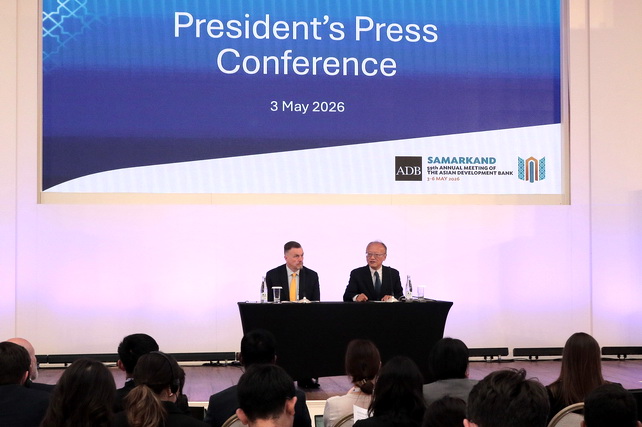
Tashkent, Uzbekistan (UzDaily.com) — The Asian Development Bank (ADB) plans to mobilize US$70 billion by 2035 to develop cross-border energy grids and digital infrastructure across the Asia-Pacific region, ADB President Masato Kanda said on Sunday, 3 May, at a press conference in Samarkand opening the bank’s 59th Annual Meeting.
“Access to energy and digital technologies will define the future of the region,” Kanda said. He added that linking energy systems and digital networks across borders would reduce costs, expand opportunities and provide reliable electricity and internet access to hundreds of millions of people.
The initiative is divided into two main components. The Pan-Asia Grid Integration Initiative (PAGI) aims to mobilize US$50 billion for the construction of cross-border energy infrastructure. The second component, the Asia-Pacific Digital Highway, targets US$20 billion to develop digital corridors and data centers.
Under the energy initiative, ADB, together with governments, utilities, the private sector and development partners, plans to build about 22,000 kilometers of transmission lines, integrate around 20 gigawatts of renewable generation into cross-border grids, and reduce emissions in the regional power sector by approximately 15 percent. By 2035, about 200 million people are expected to gain access to reliable electricity, while the projects are projected to create 840,000 jobs.
The bank expects to finance about half of the total amount from its own resources, with the remainder raised through co-financing mechanisms, including private capital. Up to US$10 million will be allocated for technical assistance to harmonize regulatory frameworks, develop common technical standards and prepare feasibility studies.
The initiative marks a shift from bilateral agreements toward a fully regional approach and builds on existing programs, including ASEAN power integration efforts and the CAREC Energy Strategy 2030, where Uzbekistan plays a key role.
The digital component includes the construction of terrestrial and submarine fiber-optic networks, satellite communication channels, regional data centers, as well as programs on cybersecurity regulation and digital literacy. According to ADB estimates, by 2035, 200 million people will gain access to broadband internet for the first time, while 450 million others will receive faster and more stable connectivity. Internet costs in remote and landlocked areas are expected to fall by about 40 percent, and the initiative is projected to generate 4 million jobs. Of the US$20 billion allocated for the digital highway, ADB plans to provide US$15 billion from its own funds.
A separate element of the initiative will be an Innovation and Artificial Intelligence Development Center to be established in Seoul with support from the government of the Republic of Korea, which will contribute US$20 million. By 2035, the center is expected to train around 3 million specialists in digital technologies and artificial intelligence, with a focus on youth and women.
Kanda said the initiatives are being launched amid a severe crisis triggered by the Middle East conflict, which he described as the most painful challenge for the Asia-Pacific region. He said the impact initially hit the energy sector but quickly spread to fuel, freight transport, food and fertilizers. On March 23, ADB announced a financial support package for developing member countries affected by the economic consequences of the conflict, including short-term trade financing, rapid budget support to protect vulnerable groups and medium-term resilience tools.
Kanda also highlighted Uzbekistan’s role, describing it as a reliable partner of the bank and noting that both initiatives directly relate to the country’s interests in expanding energy and digital connectivity with neighboring states. He said improved infrastructure connectivity would help reduce inequality and expand access to basic services in remote areas, and that ADB support for Uzbekistan would continue to expand across all key sectors.