Stay up to date with the latest news
Subscribe to our telegram channel

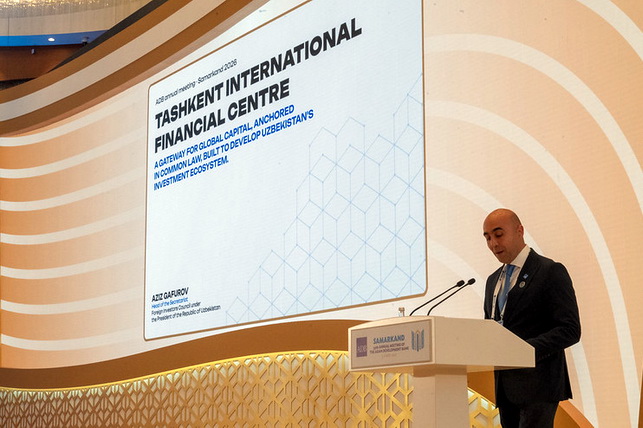
Uzbekistan Targets US$25 Billion via TIFC by 2030
Tashkent, Uzbekistan (UzDaily.com) — Uzbekistan expects to attract between US$20 billion and US$25 billion in additional portfolio investment and increase annual GDP growth by one percentage point through the creation of the Tashkent International Financial Centre (TIFC) by 2030, Aziz Gafurov, head of the Secretariat of the Foreign Investors Council under the President of Uzbekistan, said at the Asian Development Bank’s annual meeting in Samarkand.
In addition to macroeconomic gains, the project is expected to create 15,000 high-skilled jobs and provide retraining for 10,000 specialists in finance, law, digital technologies, and ESG. Authorities also expect higher tax revenues from resident companies, stronger financial stability and national currency resilience, and improvements to the country’s legal and judicial systems.
TIFC was established by Presidential Decree No. UP-48 dated March 30, 2026. According to Gafurov, the center is not an isolated reform but a logical next step in Uzbekistan’s investment climate development, directly responding to concerns consistently raised by investors through the Foreign Investors Council platform.
He said recent market developments underline the project’s relevance. The successful IPO of UzNIF demonstrated strong investor demand, while the participation of Franklin Templeton and BlackRock confirmed that Uzbekistan has firmly entered the focus of the global investment community. At the same time, he noted, attracting and retaining such capital requires a corresponding financial infrastructure.
Gafurov pointed to international examples of successful financial centers. The City of London accounts for around 12% of the UK’s GDP, supports 2.5 million jobs, and generates exports exceeding US$88 billion. The Dubai International Financial Centre contributes about 12% of Dubai’s GDP with 47,000 employees and financial activity exceeding US$800 billion.
He also noted that the Qatar Financial Centre attracted around US$32 billion in foreign direct investment over 15 years, equivalent to roughly 3–4% of the country’s annual GDP. According to Gafurov, the common factor behind the success of these institutions is legal certainty, transparent and independent regulation, and continuous adoption of international best practices.
He said the strategic objective of TIFC extends far beyond creating investment infrastructure.
The center is positioned as a catalyst for the systemic transformation of Uzbekistan, serving as a tool for capital market development, strengthening the legal system, and integrating the country into global financial networks. The model is based on common law principles, with English law directly applied within the center and disputes handled by an independent TICC court. All documentation will be maintained in English.
The center’s tax regime is designed to maximize competitiveness. Until 2076, residents will benefit from zero corporate tax, VAT, property tax, customs duties, and taxes on securities transactions, dividends, and capital gains.
Uzbek citizens employed by TIFC will be subject to a preferential personal income tax rate of 7%. The framework will also allow free capital repatriation, cryptocurrency transactions, and five-year visas for employees and their family members without work permits, while complying with OECD standards and BEPS principles.
Sector priorities include banking, capital markets and asset management, fintech, Islamic and green finance, as well as legal and consulting services. The target audience includes regional corporations, institutional investors, private equity and venture capital funds, family offices, and digital asset market participants.
A unified digital platform will be launched for residents to simplify registration and licensing procedures.
The roadmap предусматривает two phases: operational and legal preparation throughout 2026, followed by the official launch in early 2027. A dedicated TIFC project office has already been established, and work is underway on draft legislation for the center with broad stakeholder involvement.
Implementation is being carried out across seven workstreams with the participation of leading international experts. Gafurov said the guiding principle is not maximum liberalization, but the creation of a balanced, transparent, and clearly regulated system aligned with international standards.
Concluding his remarks, Gafurov highlighted the symbolism of Samarkand as the venue for the forum, noting that the historic Silk Road city once served as a crossroads for trade and capital flows — a historical precursor to modern financial centers.
He called on international partners, including the Asian Development Bank, to participate in the next stage of cooperation and become part of a new chapter in regional financial integration.