Stay up to date with the latest news
Subscribe to our telegram channel

Uzbekistan Promotes Soil and Water-Saving Farming Tech
Tashkent, Uzbekistan (UzDaily.com) — A field day was held in the Kamashi district of Uzbekistan’s Kashkadarya region on the topic “No-tillage crop cultivation technologies and rainwater harvesting on rainfed lands.” The event took place within the framework of the FOLUR Uzbekistan project, titled “Food Systems, Land Use and Restoration Impact Assessment in Uzbekistan.”
The project, funded by the Global Environment Facility, is being implemented by the National Committee of the Republic of Uzbekistan on Ecology and Climate Change, the Ministry of Agriculture of the Republic of Uzbekistan, and the Food and Agriculture Organization of the United Nations (FAO).
The main objective of the initiative is to introduce modern sustainable practices and innovative solutions for developing inclusive production landscapes based on wheat cultivation and improving value chains.
The event was attended by Deputy Minister of Agriculture of the Republic of Uzbekistan Jamshid Abduzukhurov, Deputy FAO Representative in Uzbekistan Sherzod Umarov, representatives of relevant ministries, regional agricultural departments, farming enterprises, experts, and project partners.
During the seminar, participants were introduced to the principles and advantages of resource-saving and soil-protection technologies implemented under the FOLUR project. Special attention was given to soil fertility preservation, efficient soil moisture management, rational use of plant residues, and agricultural adaptation to climate change.
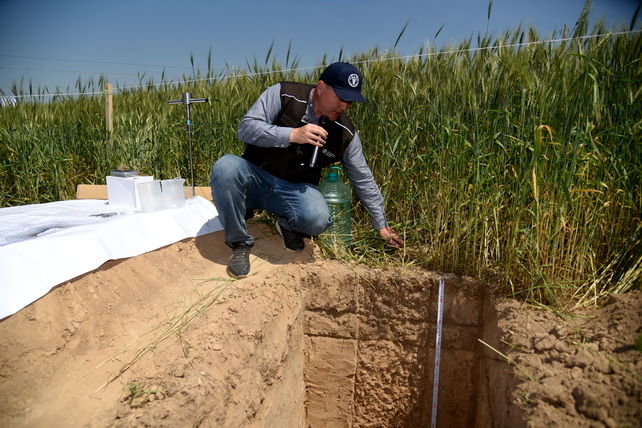
At demonstration plots, participants observed the practical application of no-till technology, which involves cultivating crops without mechanical soil tillage. Methods for soil profile analysis, infiltration rates, soil density, and moisture retention were also demonstrated.
Field demonstrations showcased results of winter wheat cultivation without tillage, crop rotation practices, and the preservation of plant residues on the soil surface. Participants were able to compare the effectiveness of traditional farming methods with modern resource-efficient technologies.
One of the key components of the event was the presentation of rainwater harvesting and efficient water use technologies. Under the FOLUR Uzbekistan project, such solutions have been implemented at three sites covering a total area of 6 hectares in the Kashkadarya region.
The technologies included stone-reinforced terraces for steep slopes, unreinforced terraces for moderately sloped areas, as well as trenches, water-harvesting pits, and water-directing strips for low-slope terrain.
Special attention was given to rainwater accumulation technologies for pistachio plantations during the growing season. Participants were shown semicircular water-harvesting structures designed to retain soil moisture and direct it to plant root systems. Such approaches were highlighted as particularly important for improving agricultural resilience in arid regions and adapting to climate change.
During the field day, farmers and specialists exchanged practical experience and discussed issues related to improving yields, preserving soil fertility, efficient water use, and expanding sustainable agricultural technologies on rainfed lands.
Organizers emphasized that such field seminars contribute to the dissemination of modern agricultural practices and strengthen cooperation between farmers, the scientific community, government bodies, and international organizations.
FAO noted that, together with partners, it will continue supporting the introduction of soil-conservation, water-saving, and climate-resilient technologies in Uzbekistan aimed at developing sustainable food systems, restoring land resources, and increasing the resilience of farming enterprises.