Stay up to date with the latest news
Subscribe to our telegram channel

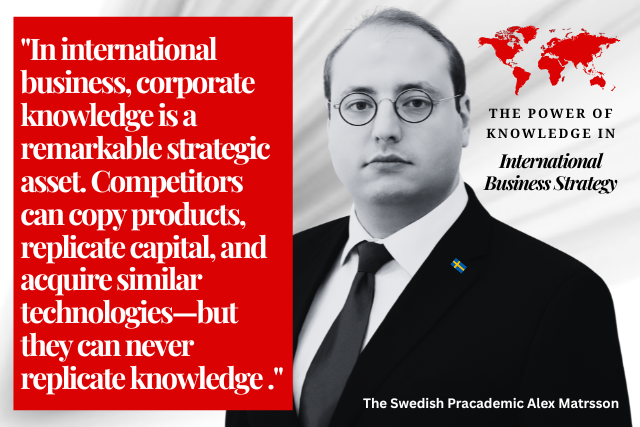
Knowledge and Internationalization: Strategic Considerations for Uzbek Firms Seeking Global Expansion
Tashkent, Uzbekistan (UzDaily.com) — In an exclusive interview, Mr. Alex Matrsson, the Swedish Pracademic and International Business Strategist, eloquently explains that knowledge has become the cornerstone of modern international business strategy. It is no longer a mere asset but the very essence of competitive advantage, the catalyst for growth, and the driving force behind innovation. As firms expand across borders, the ability to integrate and apply knowledge is no longer a static resource but a dynamic and evolving process that underpins long-term success. According to Mr. Matrsson, the complexities of global markets demand an in-depth understanding of how knowledge is created, shared, and applied, transforming it from a static commodity into a fluid and powerful competitive tool.
For Uzbek firms seeking to strengthen their foothold in international markets, Mr. Matrsson underscores the critical distinction between explicit and tacit knowledge. While explicit knowledge, codified and easily transferable, remains vital for operational efficiency and decision-making, it is tacit knowledge, rooted in personal experience and organizational culture, that proves to be the most valuable in global business. Tacit knowledge empowers firms to navigate diverse markets, offering the nuanced insights necessary to adapt to local conditions, insights that competitors cannot easily replicate. For Uzbek firms, it is the tacit knowledge embedded in their workforce and organizational culture that provides the subtle advantages fueling long-term success in international environments.
As these firms expand their global operations, Mr. Matrsson advises that they must prioritize the development of dynamic capabilities. These capabilities allow firms to integrate, build, and reconfigure internal and external competencies in response to rapidly changing market conditions. Dynamic capabilities provide the flexibility necessary to stay ahead of technological advancements and emerging opportunities. For Uzbek firms, adopting these capabilities is critical to staying agile, reshaping their strategic direction, and responding effectively to new information and challenges in global markets.
Further, Mr. Matrsson emphasizes the importance of absorptive capacity for Uzbek firms. Absorptive capacity, which refers to the ability to recognize, assimilate, and apply external knowledge, is central to successful international expansion. He stresses that firms with high absorptive capacity are better positioned to integrate new information and refine their strategies to adapt swiftly to the dynamic nature of the global market. For Uzbek firms seeking to enter new markets, engage in cross-border collaborations, or drive innovation in foreign contexts, building strong absorptive capacity is key to navigating the complexities of international business.
According to Mr. Matrsson, organizational learning is another crucial element in the success of Uzbek firms expanding globally. Effective knowledge management systems are essential to creating a culture in which knowledge is continuously generated, shared, and applied. Organizational learning, as Mr. Matrsson explains, is an active, ongoing process in which firms refine their strategies and adapt based on feedback and emerging trends. By fostering an environment where knowledge flows freely between different units and geographies, Uzbek firms can ensure their teams remain agile and well-equipped to meet the demands of an ever-changing global marketplace.
Mr. Matrsson also delves into the challenges of knowledge transfer, particularly when it comes to tacit knowledge. He acknowledges that while knowledge transfer is essential for scaling operations and fostering innovation, it requires deliberate mechanisms such as mentoring, training programs, and collaborative networks. For Uzbek firms, establishing strong knowledge transfer systems is vital for successfully sharing tacit knowledge across borders, particularly when adapting insights from one market to another. Mr. Matrsson advises that effective knowledge transfer will enable Uzbek firms to innovate and compete more effectively in unfamiliar international environments, laying the foundation for sustained global competitiveness.
Innovation, Mr. Matrsson notes, is the key driver that links knowledge to competitive advantage. By leveraging both tacit and explicit knowledge, Uzbek firms can develop new products, services, and business models tailored to the diverse needs of global markets. Innovation is about recombining existing knowledge in new and unique ways to create value propositions that set firms apart. Mr. Matrsson believes that Uzbek firms that foster a culture of innovation, where knowledge is continuously exchanged and applied, will be well-positioned to anticipate market shifts and deliver solutions that place them ahead of their competitors.
Mr. Matrsson argues that in today’s globalized world, sustainable competitive advantage increasingly depends on knowledge. Unlike tangible assets, knowledge cannot be easily replicated or imitated. It is deeply embedded in organizational practices and routines, and this intangible asset can provide a long-lasting competitive edge. He advises Uzbek firms to strategically manage their knowledge base, protect proprietary insights, and cultivate a culture of innovation to defend their market positions and sustain long-term success on the global stage.
Reflecting on the importance of strategic renewal, Mr. Matrsson stresses that firms must continually reassess and recalibrate their strategies to remain relevant in an ever-evolving global landscape. Strategic renewal involves revisiting a firm’s approach to markets, products, and competitive positioning. By learning from past experiences and incorporating forward-looking insights, firms can stay agile and responsive to shifting market conditions and technological advancements. For Uzbek firms, continuous reflection and adaptation will be essential to maintaining competitiveness and capitalizing on emerging global opportunities.
In conclusion, Mr. Alex Matrsson emphasizes that the integration and application of knowledge in international business strategy is a continuous, dynamic process requiring ongoing attention and adaptation. He asserts that Uzbek firms that successfully integrate tacit and explicit knowledge, leverage dynamic capabilities, develop absorptive capacity, and foster a culture of organizational learning will be best positioned for success in the global marketplace. As the global business landscape continues to evolve, Mr. Matrsson concludes that it is those firms that treat knowledge as both a strategic asset and a dynamic process, constantly creating, transferring, and renewing it, that will shape the future of global competitiveness.
About Mr. Alex Matrsson
Mr. Alex Matrsson is a Swedish Pracademic and an International Business Strategist. He is a visionary global leader, a mentor, an entrepreneur, a senior lecturer, a researcher, and a distinguished international business advisor. He is the number one International Business Strategy graduate in Sweden. He has extensive experience initiating, running, and managing businesses across the global value chain, as well as working internationally with investors, SMEs, MNCs, government agencies, universities, and multidisciplinary research institutes. Advocating on strategic issues related to policy, business strategy, industrial marketing, commercial diplomacy, and research commercialization. When it comes to higher education, Mr. Matrsson believes in serendipity, innovation, and the power of synergy-making. Therefore, these concepts jointly constitute the springboard for his knowledge dissemination endeavors. He implements a pragmatic approach that is rigorous in nature. He systematically ensures the successful delivery of core business concepts, while simultaneously developing the students' ability to become reflexive thinkers. He aims to enable the students to operationalize their "state-of-the-art" knowledge constructively—so that they can become an invaluable source of prosperity, driving forward the "social" and "economic" well-being for their local communities, their regions, and the larger society, worldwide. His scientific endeavors consolidate around trade promotion, emerging markets, business resilience, and the network approach to internationalization. Mr. Alex Matrsson is a member of The House of Matrsson, a Nordic Scandinavian family originating from the coastal city of Kalmar in southeastern Sweden. Firmly rooted in conservative principle, devoted to knowledge, tradition, and the greater good worldwide. Finally, on a personal level, his wide-ranging interests include blue whales, Arabian horses, classical music, ethical capitalism, religion, culture, the Nordics, the GCC region, and Central Asia—particularly Kazakhstan.