Stay up to date with the latest news
Subscribe to our telegram channel

Eco Expo Central Asia 2026 to Boost Uzbekistan Green Agenda
Tashkent, Uzbekistan (UzDaily.com) — The National Committee of the Republic of Uzbekistan on Ecology and Climate Change has stated that the country’s environmental agenda is entering a new stage of international and institutional development.
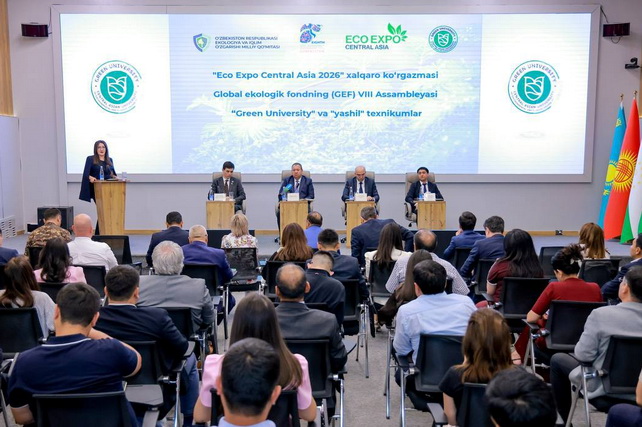
At a press conference held at Green University, key directions were presented for preparations for the international exhibition Eco Expo Central Asia 2026, the 8th Assembly of the Global Environment Facility, as well as plans to develop environmental education through a network of “green” technical colleges.
The event demonstrated that Uzbekistan’s environmental policy is gradually moving beyond isolated conservation initiatives and is forming a comprehensive sustainable development strategy covering education, investment, international cooperation, and the green economy.
Environmental diplomacy as a tool of regional leadership
The hosting of the 8th Assembly of the Global Environment Facility in Uzbekistan is becoming one of the largest environmental events in the region. Representatives from more than 100 countries, international financial institutions, environmental organizations, and investors are expected to participate.
According to Deputy Minister of Ecology Zhusipbek Kazbekov, special attention within the events will be given to climate adaptation, biodiversity conservation, land degradation control, water resource management, and reducing environmental pollution.
For Uzbekistan, hosting such events has significance beyond image-building. The country aims to establish itself as a regional platform for discussing the climate and environmental agenda of Central Asia. This is particularly relevant amid growing climate risks linked to water scarcity, desertification, and changing temperature patterns.
The Assembly is expected to serve as a platform for attracting international grants, launching new transboundary initiatives, and expanding cooperation with institutions such as the Asian Development Bank, the European Bank for Reconstruction and Development, and the Global Green Growth Institute.
Eco Expo Central Asia 2026: environment becomes part of the economy
The international exhibition Eco Expo Central Asia 2026 reflects another important trend — the transformation of environmental issues into a full-fledged economic sector.
According to organizers, the exhibition will bring together more than 68 pavilions showcasing environmental technologies, solutions, and services. Participants will include major international companies and investors from Saudi Arabia, France, China, Japan, Finland, the United Arab Emirates, and other countries.
Special attention will be given not only to technology demonstrations but also to the practical promotion of investment projects. Regions of Uzbekistan have already prepared proposals related to climate adaptation, renewable energy development, waste processing, and the rational use of natural resources.
In effect, the exhibition is becoming a platform where the environmental agenda is integrated with industrial modernization and the country’s investment policy.
Green University and “green” technical colleges: focus on environmental skills
One of the most strategically important directions is the development of environmental education.
Green University is currently positioned as the first specialized environmental university in Central Asia. The institution implements programs in sustainable development, green economy, environmental law, circular economy, and sustainable finance.
Particular importance is attached to the creation of 14 “green” technical colleges across all regions of the country under the “Eco-Culture” project, implemented in accordance with Presidential Decree No. 110 dated March 25, 2026.
The new model introduces a continuous education system: graduates of technical colleges will be able to continue their studies from the second year of university, provided they meet the required academic level and English language proficiency.
This approach reflects an understanding that climate transformation requires not only investment and technology but also the development of a new generation of specialists capable of operating within a green economy.
Environmental agenda as a driver of economic transformation
Today, Uzbekistan’s environmental policy is increasingly integrated into the national economic development strategy.
While just a few years ago the green agenda was viewed primarily as environmental protection, it is now becoming part of the country’s investment, industrial, and educational policy.
The organization of international environmental forums, the development of specialized education, engagement with global institutions, and the launch of dedicated infrastructure projects demonstrate Uzbekistan’s ambition to integrate into the global sustainable development architecture.
In the context of the global transition toward a low-carbon economy, the ability to adapt to new environmental standards may become one of the key factors determining the competitiveness of countries in the region.